Rigid‑Flex & HDI Boards
Space‑saving rigid‑flex and HDI boards.
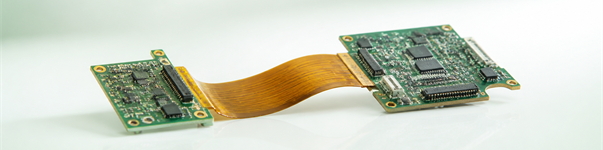
What rigid-flex and HDI bring
Rigid-flex and HDI boards remove connectors and merge rigid sections with flexible circuits in one stack-up. The result is less weight, fewer interconnection points, and better signal integrity - ideal for devices where space and reliability are both tight.
Stack-up capabilities
- Blind and buried micro-vias, via-in-pad, and 0.2 mm pitch for high-density routing
- Flex and rigid-flex from 2 to 20+ layers, including impedance-controlled designs
- Polyimide and coverlay materials rated for flex cycling and thermal stress
- Tight impedance control for RF, high-speed, and differential pairs
Typical applications
These boards power medical instruments, aerospace and defense systems, wearables, and 5G telecom modules - places where every gram and every connector removed improves the product.
Why teams choose Donlly
- Prototype-to-production on the same line, so the flex behavior you validated ships unchanged
- Stack-up and bending-radius guidance that protects yield in the field
- AOI, X-Ray, and electrical test matched to fine-pitch HDI
Have a 3D constraint or a dense layout? Talk to our team and we will review the stack-up before fabrication.
Reliability you can qualify
Flex circuits almost always fail at interfaces rather than in the copper, so we focus extra attention on bend radius, stiffener placement, and coverlay adhesion from the first article. Prototypes can be built with representative bend cycles for your evaluation, and production lots carry the same electrical test plan so what you qualified is what ships. We document the stack-up, the materials, and the test results together, giving your program a clean file to present to customers or regulators. The aim is a flex assembly that survives installation and years of field use - not one that merely passes a bench check before it leaves our dock. For high-layer counts we model the stack-up with you so insertion loss and cross-talk stay within spec before fabrication, and if your product bends in service we design the flex zone to tolerate it rather than hope.